Monday, October 31, 2011

Twain's Bloody Massacre


Insensitive, moi?
Was a real life incident in July 1863 part inspiration for one of Mark Twain's most famous newspaper hoax articles?

[Warning: I am about to quote some fairly graphic descriptions of death by Bowie knife]

Before Mark Twain was a genial, white-haired, much-beloved raconteur, he was a hard-drinking, hot-tempered, pipe-puffing reporter with "mutton chop" sideburns and no mustache. (left) He lived in Virginia City (famous for being the setting of the TV series Bonanza) and he wrote for the Territorial Enterprise Newspaper. The Comstock, as that region was called, was wild and woolly, full of "thieves, murderers, desperadoes, ladies, children, lawyers, Christians, Indians, Spaniards, gamblers, sharpers, coyotes, poets, preachers, and jackass rabbits." Despite this rich vein of journalistic gold, Sam Clemens – who had not yet adopted the pseudonym Mark Twain – was not afraid of slandering local residents or even of making up hoax stories to fill blank pages of the paper.

His first hoax, early in October of 1862, was an article about a Petrified Man found in the Nevada desert east of Virgina City. Twain describes a prospector with a wooden leg who was found turned to stone at a place called Gravelly Ford. He describes the man's position, and if any of his readers had bothered to adopt the pose – or even mentally visualise it – they would have realised immediately that Twain was joshing them. (He even signed that article "Josh") One of his main aims in writing this hoax piece was to vex an enemy of his, a man named George Sewall with whom he was feuding. And he succeeded. People generally do not expect the printed word to be an outright lie.

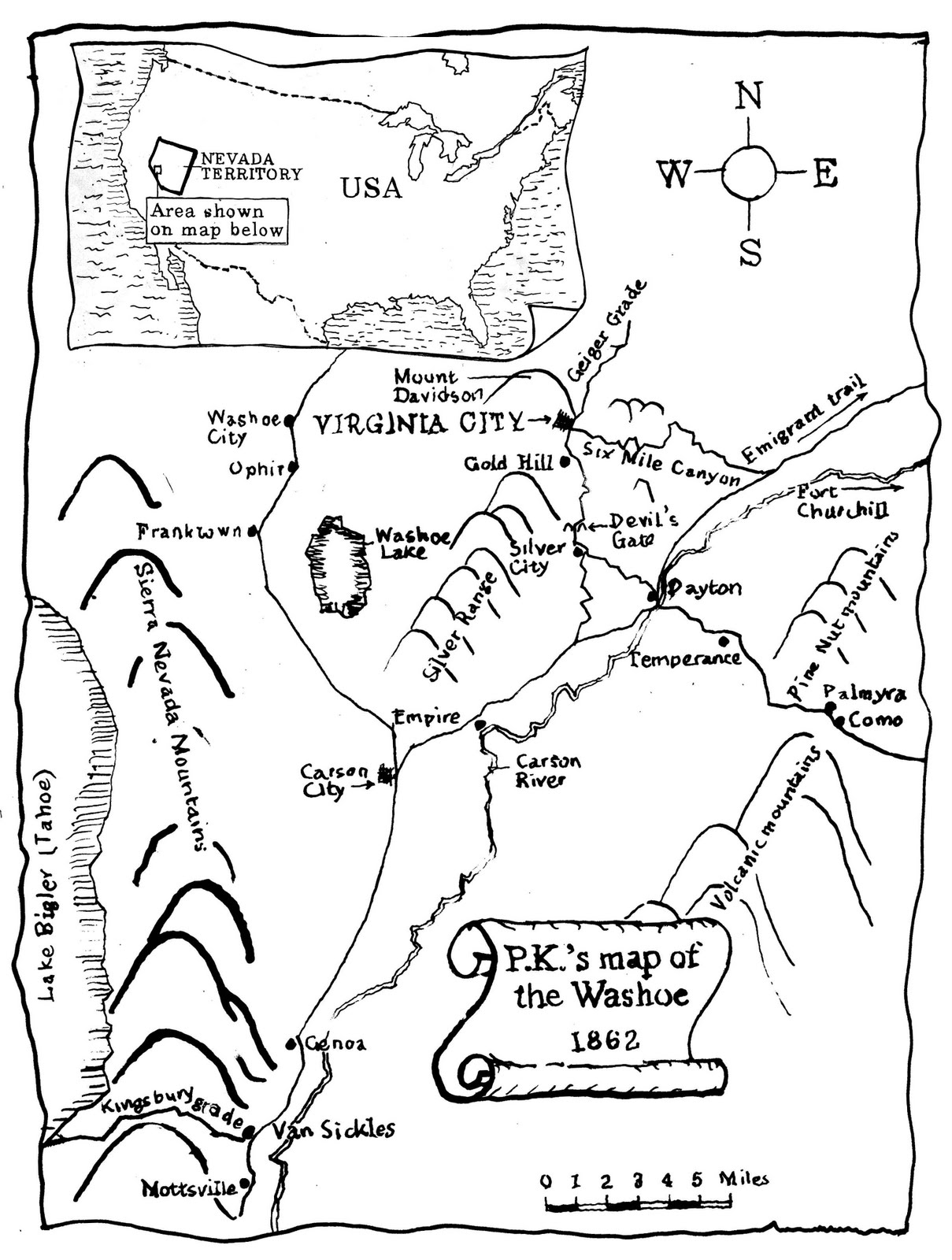
A year later, Twain wrote another hoax, a truly grisly piece about a man living in Empire City who supposedly kills and mutilates his family, cuts his own throat from ear to ear, then rides three miles before dropping dead on the steps of a Carson City saloon. Once again, careful readers would have read the clues and figured out that this story wasn't true. After all, how can a man ride three miles with his throat cut from ear to ear? (see map above right)

But readers of the morning paper pushed away their breakfasts in horror upon reading Twain's grisly report of the unhinged father's murder and mutilation of his family.

TE readers put off their breakfast by Twain's gory article

Territorial Enterprise, October 28, 1863

A BLOODY MASSACRE NEAR CARSON
From Abram Curry, who arrived here yesterday afternoon from Carson, we have learned the following particulars concerning a bloody massacre which was committed in Ormsby county night before last. It seems that during the past six months a man named P. Hopkins, or Philip Hopkins, has been residing with his family in the old log house just at the edge of the great pine forest which lies between Empire City and Dutch Nick's... About ten o'clock on Monday evening Hopkins dashed into Carson on horseback, with his throat cut from ear to ear, and bearing in his hand a reeking scalp from which the warm, smoking blood was still dripping, and fell in a dying condition in front of the Magnolia saloon... [even more graphically bloody details follow, which you can read HERE.]

The Journals of Alfred Doten

I've been reading (and re-reading) the Journals of Alfred Doten as part of researching my Western Mysteries stories set in and around Virginia City in the early 1860s. Like Mark Twain, Alf Doten was a failed prospector turned journalist. Throughout his life he kept meticulous and detailed journals, recounting the weather, cost of things and concrete details of life in the California gold fields and later on the Comstock, in Nevada.

This morning over breakfast I pushed away my own yogurt and strawberries in dismay as I read Doten's sad and distressing entry for 16 July 1863.

July 16 - About 8 oclock this evening a man by the name of Patrick Comerford committed suicide at the Mineral Hill tunnel, some 2 miles below here [Como, Nevada]. He was living near the mouth of tunnel with some half dozen others - he went into the tunnel and with a bowie knife he cut his throat - first ripped it up from upper part of breast bone to his chin & then cut across nearly from ear to ear, severing the jugular, windpipe &c - did the job securely - his partners heard him groan and went in and found him - he died in a few minutes - one of them immediately came up to town &c told the story - several people went down there - Briar went - he acted as Coroner and the jury gave verdict in accordance with the facts - he was an Irishman and about 35 or 40 yrs old - no reason could be assigned for the rash act - he seemed to be all right enough but somewhat troubled in his mind, and at times somewhat abstracted 
Journal of Alfred Doten p 719

As a writer who constantly draws inspiration from things I read and hear about, I am pretty sure that poor Patrick Comerfield's bloody suicide in July 1863 was partly the inspiration for Twain's "Bloody Massacre" hoax, written three months later. The gruesome details of Comerford's suicide must have spread like wildfire even if not reported by local papers.

Thus it is not too surprising that many Comstockers believed Twain's similar but greatly embellished account of a bloody suicide by Bowie knife. In fact, the article caused such horror and outrage that, Twain had to print this retraction the very next day:

Territorial Enterprise, October 29, 1863
I TAKE IT ALL BACK
The story published in the Enterprise reciting the slaughter of a family near Empire was all a fiction. It was understood to be such by all acquainted with the locality in which the alleged affair occurred. In the first place, Empire City and Dutch Nick's are one, and in the next there is no "great pine forest" nearer than the Sierra Nevada mountains, etc. 

[For more retrospection about this hoax read Mark Twain's Sketches New and Old.]

You would think Twain might have learnt his lesson, but no. Six months later, in May of 1864, he wrote a different sort of hoax, this one about the Ladies of Carson City. As a result of this third hoax the hot-blooded young reporter was challenged to a duel by pistol and had to flee Nevada. But that's another story.

[The second book in my Western Mysteries series, is called P.K. Pinkerton and the Petrified Man in the USA and The Case of the Good-Looking Corpse in the UK.]

Thursday, September 22, 2011

Western Mysteries ABCs

A basic GLOSSARY for British children reading the Western Mysteries who might not know what a Desperado or a Stagecoach is... or where Nevada and Utah are.

America in 1862

A is for America - the country across the Atlantic Ocean where people speak English with funny accents. It is also known as the United States, but in 1862, the states only went halfway across America with a few on the west coast. A great chunk of land in the west was called "Territory". Towns in the Territories were often lawless and wild.
Is P.K. a Desperado?
B is for Ball & Blackpowder - this is what old-fashioned bullets were made of. You also needed lint and a tiny little metal cap that you put on the back of each hole in the cylinder of your Revolver to make a spark which set off the powder and get the ball flying towards its target. Later on they put the cap and ball and powder in one metal case called a cartridge. This is what we now call a Bullet.
A Chinese Youth
C is for Chinese (not Cowboys) - in the early 1860s, when The Western Mysteries are set, there were far more Chinese out west than Cowboys. Cattle drives did not begin in earnest until 1866.
D is for Desperado - a desperate person who is usually on the run after committing murder, robbery or other serious crime.
E is for Emigrants - most of the people who flooded to America in the 1800s were emigrants from Euorpean countries like England, Scotland, Ireland, Germany, France, Russia, etc. And, of course, the thousands from China.
F is for Frontier - the place in the American West where settled land gave way to wilderness populated by wild animals and Native American tribes.
A Gunslinger
G is for Gunslingers - almost everybody carried a firearm in the 1860s out west, even women & kids.
H is for Horses - The West in the early 1860s was a world mostly driven and powered by animals with hooves like horses, mules and oxen.
An Indian Tomahawk
I is for Indians or Native Americans - the tribes of people already living in North America when the emigrants arrived were as varied as the people from European countries, sometimes more so.
J is for Jackrabbit, also coyote, grizzly bear, prairie dog, buffalo and all the other unique wildlife found in the West.
A Kerosene Lamp
K is for kerosene or coal-oil, which is what folk used to light their lamps. They used candles, too. In 1862 gas had not quite reached Virginia City.
L is for Lincoln - who was president between 1861 and 1865 when America was fighting a terrible Civil War over slavery and freedom.
26-year-old Mark Twain
M is for Mark Twain - his real name was Sam Clemens and he was one of America's greatest authors and humorists. He joined the Civil War for about two weeks then headed west to Nevada Territory with his brother Orion, who had been appointed secretary to the governor. After trying his hand at prospecting, Mark Twain became a reporter in Virginia City where he remained for two and a half years. Many years later he wrote Tom Sawyer & Huckleberry Finn, among others.
N is for Nevada - then a "Territory" and now the triangular state to the right of California, (see maps). It is full of deserts, mountains and minerals.
O is for Ore - rock and/or dirt containing precious metals or minerals. The Gold Rush in 1849 brought a huge wave of people to California, then ten years later the Silver Boom brought thousands Nevada, to the Comstock Lode beneath Mount Davidson.
P is for Pinkerton - the first detective agency in the world. The founder, a Scotsman named Allan Pinkerton, coined the phrase "Private Eye". Their head office was in Chicago, Illinois (one of the high-up states in the middle).
A Quartz Stamp Mill
Q is for quartz stamp mill - a machine with heavy iron pistons that crushed quartz so that silver and gold could be extracted.
R is for religious revival - America was going through a great Christian revival in the 1860s and almost everybody was deeply devout.
S is for stagecoach - a large, closed carriage pulled by four to six horses; it was used to carry passengers, goods and mail on a regular route. Sometimes you could ride on top.
T is for tobacco - like religion, almost everybody had tobacco. They either smoked it, sniffed it or chewed it. Those who chewed usually spit their tobacco-tinted saliva into vessels called spittoons. Ew.

A Stagecoach

U is for Utah - now the state to the right of Nevada on a map, then it was a "Territory", a part of America which did not yet have the full rights of the other states.
Nevada Territory 1862
V is for Virginia City - the mile-high city on a steep mountain above a buried "ledge" of silver called the Comstock Lode.
W is for Washoe - the region around Virginia City, named after a lake to the west (see map) and also a tribe of Indians who lived there.
X is for "X marks the Spot" - Prospectors were people who prospected or "looked out for" areas where gold or silver could be found. Then they "staked their claim" i.e. announced it as theirs. They guarded their claims with bowie knives, revolvers, rifles... and their lives.
Y is for Yankee or Yank - slang for somebody from the northern states or on the Union side of the Civil War. A person on the other (Confederate) side was often called a Reb or Rebel.
Washoe Zephyr
Z is for zephyr - by definition a warm and gentle breeze. In Virginia City, a Washoe Zephyr was what people jokingly called the gale force wind that sometimes swept over the mountains and threatened to uproot trees and houses.

If you would like to read a book with all these words and a heck of a lot of adventure, get The Case of the Deadly Desperados by Caroline Lawrence. It is available in hardback, Kindle and unabridged audiobook format. Suitable for children aged 9+. Perfect for American history at Key Stages 2 & 3.

Wednesday, August 24, 2011

Stagecoach Etiquette


These tips for people travelling by stagecoach come from a 1877 issue of the Omaha Herald newspaper. They give you a good idea of how uncomfortable it must have been to make long journeys by stagecoach in olden days, and they don't even mention the poor sods who had to sit on top!

an overcrowded stagecoach
The best seat inside a stage is the one next to the driver. Even if you have a tendency to sea-sickness when riding backwards - you'll get over it and will get less jolts and jostling. Don't let "sly elph" trade you his mid-seat.

In cold weather, don't ride with tight-fitting boots, shoes or gloves. When the driver asks you to get off and walk, do so without grumbling, he won't request it unless absolutely necessary. If the team runs away - sit still and take your chances. If you jump, nine out of ten times you will get hurt.

In very cold weather abstain entirely from liquor when on the road, because you will freeze twice as quickly when under its influence.

Don't growl at the food received at the station - stage companies generally provide the best they can get.

roads were hair-raising
Don't keep the stage waiting.

Don't smoke a strong pipe inside the coach.

Spit on the leeward side...

Don't lean or lop over neighbours when sleeping.

Take small change to pay expenses.

Never shoot on the road as the noise might frighten the horses. Don't discuss politics or religion.

Don't point out where murders have been committed, especially if there are women passengers.

Don't lag at the wash basin. Don't grease your hair, because travel is dusty. Don't imagine for a moment that you are going on a picnic. Expect annoyances, discomfort and some hardships.

Find out more about Stagecoaches, Saloons, Spittoons, and Scalpings at my Western Mysteries session on Friday 26 August 2011 from 4.00-5.00 at the Edinburgh Book Festival. 

watch the mini-trailer on YouTube
Trailer for the first Western Mystery, The Case of the Deadly Desperados

Wednesday, August 17, 2011

Virginia City 1862


Virginia City, Nevada Territory - September 1862.

P.K. Pinkerton, Private Eye
When desperados kill the preacher and his wife in a small frontier town, their foster child P.K. is forced to go on the run. P.K. must get a valuable letter to the Recorder’s Office before anyone else can get their hands on it. It’s not easy: Virginia City is full of gamblers, hurdy girls, saloon-keepers and gunmen, all of them on the make. But there are possible allies: Sam Clemens, the new reporter for the paper, a gambler called ‘Poker Face Jace’, a derringer-packing Soiled Dove, and a Chinese photographer’s apprentice named Ping.

Map of the Washoe
Virginia City was a famous mining town in Nevada that sprang up on the slopes of Mt Davidson in 1859, ten years after the California Gold Rush. But it was silver, not gold, that was found in quantity in this barren part of Nevada, so some have dubbed it the Silver Rush. When Mark Twain arrived in September 1862 he described Virginia City in this way: ‘It claimed a population of fifteen thousand to eighteen thousand, and all day long half of this little army swarmed the streets like bees and the other half swarmed among the drifts and tunnels of the “Comstock”, hundreds of feet down in the earth directly under those same streets.’

In the 1860's Virginia City must have been one of the most colorful places on earth, with prospectors, miners, saloon-keepers, gamblers, dancing girls, deserters, actresses, desperados, lawyers, schoolmarms and newspapermen. In the last category are some well-known names (Dan De Quille, Alf Doten, Joe Goodman) and one stellar one: Mark Twain. Their dry-as-dust humor, tall tales and hoaxes produced a uniquely Western flavor of literature which some call "Sagebrush Humor."

Sam Clemens is Mark Twain
The Comstock in 1862 was an extreme example of what we might call "politically incorrect". People gambled, cursed, smoked, spat, drank, carried firearms, murdered one another, ate opium, sparked, and exhibited racism at its worst. It was an ethnic melting pot, boasting Irish, Germans, several tribes of Native Americans, African Americans, Chinese and Mexican residents. Many of the inhabitants had come west to avoid the horrors (or duty) of fighting in the War between the States. Almost everyone came to get rich, though there were a few who came to save souls of others or lose their own.

In short, Virginia City was a crucible; it made some great, and destroyed others. What will happen to 12 year old P.K. Pinkerton? Read the Western Mysteries to find out.

Western Mysteries author Caroline Lawrence will be talking about her new series at the Edinburgh Festival from 5.00-6.00pm on Friday 26 August 2011. For more info, and to book, go HERE.

Friday, July 1, 2011

Historical Inaccuracies Rule!


Try to avoid anachronisms
One of the challenges of writing historical fiction for children to balance accuracy and fun. It's no good having a bazillion accurate facts if the books are dry as dust. And it's no good telling a ripsnorting yarn if your story isn't at least 95% accurate.

In my Roman Mysteries I was meticulous about getting historical details, events and people as accurately as possible, but I made my hero – the 10-year-old detectrix Flavia Gemina – as independent as any 21st century schoolgirl. Maybe more so. I needed to make Flavia and her pals accessible so that children could identify with them and enter the world and so absorb the details of the period. It was a balancing act, challenging but fun. I tried not to let too many inaccuracies creep in, but one or two per book were necessary. 

Virginia City re-enactor
I have the same problem with my new Western Mysteries series, set in Virginia City, Nevada Territory, in 1862. To me it is deeply thrilling. I have the Civil War, Indian battles, the Salting of Silver Mines, Runaway Slaves, Mark Twain & other priceless primary sources. Plus Virginia City is still there and chock full of museums, mine shafts, lively saloons (!) and historical re-enactors. But it's still going to be a hard sell to children aged 9+ in the UK. To them this time and place is deeply unsexy. Their grandfathers liked Western movies for heaven's sake. How uncool is that? 

So, in a bid to make the period immediately engaging and fun, I went to five of the most famous visual images of the Western: blazing six-shooters, the Stetson hat, sheriff's badges, swinging saloon doors and WANTED posters. The problem is, all five of these iconic artefacts are basically myth. Especially in Nevada Territory in 1862. But I decided to indulge myself with two of them. 
the author with replica Colt & badge

Myth #1 - Blazing six-shooters
This is the image of 90% of the Westerns you see on TV or in cinemas. The myth is so strong it has spawned Cowboy Fast Draw as a new sport, especially popular in states like Nevada and Arizona, where almost anybody can carry a loaded firearm. I had huge fun in May at the Genoa Cowboy Festival. I got to fire a revolver at targets with wax-filled cartridges. Anything under 1 second is considered good. The champions can draw, cock, fire and hit the target in under half a second. 
Denied! At the time my books are set – 1862-63 – cartridges were brand new. Most guns needed to be painstakingly loaded with black powder, cap, ball and wad. (I've tried this, too.) With this kind of ammo, misfires are common. When you DO hit something they often set the victim's clothes on fire. How often do we see that in movies? In old westerns, a bullet means instant death. In reality people often survived after being shot multiple times. That myth I can bust. Accounts of real historical shootouts are exciting, shocking and sometimes even amusing. 

Sheriff Tom Peasley
Myth #2 - Sheriff Badges, etc. 
Think of Gary Cooper in High Noon, dropping his badge in the dust as his response to the refusal of the town to acknowledge its authority. Or Henry Fonda in The Tin Star, where the sheriff's badge symbolises his redemption. Surely that's not a myth?
Denied! During my last research trip to Virginia City I learned that lawmen did not wear badges until 1874, a full dozen years after my first book is set. Nor did marshals, sheriffs or police (yes they had them too) wear any distinctive uniform for many years. So how did you know you were facing the law? Fascinating. I'm going to use the reality here, too, as it could provide lots of drama. But I'll carry on wearing my Virginia City Deputy Sheriff's star to parties and book launches.
The Duke in his hat

Myth #3 - Stetson Hats
Ten-gallon hats, Stetson hats & cowboy hats! Think of Steve McQueen and his disgustingly realistic-looking sweat-stained hat in The Magnificent Seven. Or John Wayne and his famous white(ish) cowboy hat. (right) Surely those are a legitimate icon of the 1860s? 
Denied! Most men in Virginia City wore something Dickens would have worn. Mr. Stetson didn't sell his first hat until 1865, a few years after my books are set. Mark Twain, (my vocabulary source for 1862), describes himself as arriving in Virginia City with a slouch hat, a soft felt hat usually of brown or black. That's the type of hat my character is wearing on the front cover of my book. So in my books my male characters wear plug hats, stovepipe hats or slouch hats. And my women are almost universally in bonnets. The dude on the black and white carte de visite up above is Tom Peasley, a famous Virginia City Sheriff from 1866.  

Myth #4 - Swinging Saloon Doors
Is there anything more iconic (or fun) about a wild Western town than The Stranger swinging in through those butterfly doors? The piano player stops, the room goes silent, everybody turns to stare and you can be sure there will be a fist-fight or a shootout before long.
Denied! One scholarly resident of Virginia City tells me that saloons there never had the famous swinging doors so beloved of Western movies. One reason may have been the hurricane force wind fondly known by the locals as the "Washoe Zephyr". It was strong enough to blow off tin roofs and carry away small mammals. 
El Indio

Myth #5 - WANTED posters
Think of all those great Western movies where the WANTED poster tells you exactly what the bad guy looks like. One of my personal favourites is in Sergio Leone's For a Few Dollars More, where the evil laughing baddie El Indio is freeze-framed mid-cackle and the image becomes his WANTED poster. 
Denied! My Nevada historian friend assures me that WANTED posters from the 1860s and 1870s were probably printed handbills with a plain verbal description. I have a replica of the WANTED poster for Lincoln's assassin up on my wall and she's right. Exclamation points, yes. Pictures, no. 

But swinging saloon doors and WANTED posters are iconic images from the Western genre, so I've decided that both of these particular myths will appear in my book and on my website. I want to tell readers – especially young readers – that this is a series about the Wild West, with cowboys and indians; gambling and drinking; horses and mules; guns and knives; action and excitement. I can do that instantly with saloon doors and WANTED posters.
So the naughty swinging doors became the portal to my website and the illustrated WANTED poster became the cover image for the book.

Wisely used, historical inaccuracies can be the spice to bring the past to life, but like spice they should be used sparingly and knowingly. The historical author should know exactly what she is doing and why. Inaccuracies through ignorance are not allowed, so if I get something wrong, don't be afraid to tell me! 

The Case of the Deadly Desperados is the Telegraph Family Book Club choice for June. Read the review and see questions for book group discussion HERE. 

Tuesday, June 14, 2011

Truly Gritty

My Top Five GRITTY Westerns for kids.

Everybody has their own definition of a “western”. Here’s my definition:
A Western doesn’t have to have cowboys or Indians but it
should have horses and/or mules.
should be set in the American west in the 1800s.
should have six-shooters, smoking, gambling and drinking.
should have a hero who fights against overwhelming odds.
should have some harsh but beautiful landscapes & big skies.

Because Westerns are usually about survival of individuals in the extreme situations of a frontier world, they are usually too violent and politically incorrect for children. The ones that ARE aimed at children are often too sanitized for my liking. I like gritty reality with a dollop of danger. So here are five of my favourite Western books; ones suitable for kids but which also have grit, grime and menace. I’ve placed them in order of ascending grittiness.

1. The Ballad of Lucy Whipple (U) by Karen Cushman
This is the tale of a girl in a California mining camp during the American Gold Rush. I like this story because it transports you to another time and place, with wonderful details about the plants, animals and climate of the Sierra Nevada mountains combined with food, clothing and equipment of gold miners in the 1850s. This is probably the safest of the five books on my list, because it was written especially for children, but like all good stories it is compelling enough for adults to enjoy, too. Plus it has plenty of grit and grime.

2. Hondo (PG) by Louis L’Amour
Louis L’Amour is considered one of the greatest Western writers and this is one of his greatest books. The story follows a strong, silent hero named Hondo who helps a woman and her son living in hostile Apache territory. The best bit of the book is a section at the end where Hondo teaches the boy how to track and hunt Indian-fashion. The John Wayne movie is good but doesn’t have the tips about tracking and desert survival.

3. True Grit (PG) by Charles Portis
This deadpan masterpiece by Charles Portis is one of my top ten fave books of all time. It recounts the story of a fourteen-year-old girl named Mattie Ross who hires a fat, half-blind Marshal to help her avenge her father’s cold-blooded murder. Both of them have ‘grit’, (which can mean ‘courage’ as well as crunchy dirt.) True Grit is one of those books you can read over and over and always find something new. Both movie versions are good, but the book is better. Best of all is the audio book, read by American author Donna Tartt. She captures Mattie Ross’s voice perfectly.

4. Boone’s Lick (PG) by Larry McMurtry
Like Charles Portis, Larry McMurtry is another great American author. His Pulitzer-prize-winning Lonesome Dove was made into a highly-acclaimed TV mini-series. His screenplay of Brokeback Mountain won an Oscar. Boone’s Lick is based on the real events of an Indian massacre in 1866, a year after the Civil War ended. The narrator is fifteen-year-old Shay. Some scenes are quite brutal, but it’s suitable for readers 10+. As with True Grit, there is a superb audiobook version, read by actor Will Patton, who makes McMurtry’s drily funny characters even better than they are on the page. No mean feat.

5. St. Agnes' Stand (15) by Thomas Eidson
WARNING: This book has harrowing scenes of torture by Apache. It made me understand why you always save the last bullet for yourself in an Indian attack. (gulp!) But if you have a strong stomach, it is a beautiful Western with a powerful message of love and redemption. And don’t forget my new book, The Case of the Deadly Desperados, which  falls between True Grit and Boone’s Lick on the True Grittiness scale.

Western Mystery #1, The Case of the Deadly Desperados, is out in the US now. Western Mystery #2, The Case of the Petrified Man, is coming in 2013. 

Inhabiting the West

yee-haw!
Virtual Stagecoach for my Western Mysteries Blog Tour

This is the final dusty stop on my blog tour to promote my new “Dime Novel”, The Case of the Deadly Desperados. It has been quite a journey but I have enjoyed it.

The first stop on my tour was a big ole Hay Festival. I did not see many Bales of Hay but I saw some International Personalities & also a passel of Authors of Dime Novels. I must have got some of that there “Hay Fever” because I shared some special secrets about my own Dime Novel. Yup, I told them all about Reading People & Writing Character. 

The next day my Virtual Stagecoach took me to Bart’s. Bart’s Bookshelf, that is. It was kind of dark in there but that Darren made me & my Driver feel real welcome. We sat by the cosy fireplace sipping whiskey while I described some places I had visited to help me Write about the West. 

Day Three was bully. I had been riding beside Douglas, the driver of my Virtual Stagecoach. I hopped down & I strode into the Book Bag (is it a Saddlery?) & announced my Fave Five Western Movies for Kids, and also my 5 for Adults, too. Nobody took a bullwhip to me, and the two lady proprietresses said I had “great taste” so I guess they liked my choices.  

My "Dime Novel"
On Saturday June 4th, Douglas drove me over to the Book Zone Saloon. It was mighty dark in there, too, but as our eyes adjusted we saw lots of Child Detectives including my three Favorites. One is called “Nancy”, one is from London & one is a mite strange. The proprietor was real friendly. He was also called Darren. I suppose I will have to put a Saloon-keeper called “Darren” into my next Dime Novel... 

There was no Sabbath Rest on Day Five. Our stagecoach made 12 Heroic Stops. Still, it was worth it to talk about Story Structure over at Miss Becky “Bookette” Scott’s Lending Library. Miss Becky is real cheerful & she liked my book a lot. I blush to say she called it “genius”. Aw, shucks. 

On the sixth day of my trip I visited a retired Schoolmarm in a town called Serendipity. She wants to write them Dime Novels, too. I told her my 5 Favorite Places to Write. Miss Viv liked my books so much that she rushed out to the local stationer & bought a passel of ’em. Not my Dime Novel, I hasten to add. My Writers’ Notebooks. 

Sarsaparilla
Monday the 7th was my seventh stop and I was glad to wet my gullet at the Fiction Thirst Saloon. The proprietor Rhys was only about 15 or maybe 16 yrs old. So we drank sarsaparilla instead of whiskey. I reminisced about my childhood and I told him about The First Gunslingers I Ever Met, back in the days when things were still in black & white. One of them dressed All in Black & one of them wore Trowsers so Tight they Split & one of them was a Master of Disguise. 

Well, by Day 8 I was getting tuckered out. So I stopped by Miss Jenny's Wondrous Place. It was all done up in purple velvet with stars on the roof and real pretty gals there, especially the proprietress, Jenny. I didn’t want to inquire too closely as to what sort of an establishment it was – some of those gals had real pale skin and sharp teeth – so I tried to distract them with Some Music. Some of their gentlemen and lady callers seemed to like my choice of songs. 

There followed another day of relaxification - Day 9 - over at Angel's Boarding House. Funny, but that place was kind of purple, too, but with leaves this time, not stars. And here is the strange thing: I told Miss Emma AKA "Angel" about my Favorite Inspirational Music and she showed me pictures on the walls that seemed to move & play the very songs I had been describing! I guess she is some kind of Magician or maybe one of them Spiritualists. 

Day Ten. After my two restful purple days, we stopped by Sheriff Karen’s Eurocrime Jail to bail out My Favourite Character from the old West. He is now riding along with us. He has 5 Christian names & 1 Silver Tooth. He wears his gun around his neck but uses belt AND braces to hold his pants up. And he just ate the cheroot I offered him. My stagecoach driver Douglas says he “stinks like a pig”, but I kind of like him. I wonder if you can guess who he is?

not the final cover
The rains came on Day 11 of our journey so that little beads of water dotted the window of Mr. Ripley’s Enchanted Books & Elixir Wagon. I told him How We Chose the Cover for my Dime Novel. He seemed pleased and said he kind of preferred the version we didn’t use. My feelings weren’t hurt none. I just hope that won’t stop him from reading it. 

Miss “Book Maven” Mary runs a respectable joint. I stopped in there on Day 12. I was expecting tea in china cups, but she gave me whiskey & a plug of tobacco! Once I recovered from this shock, I told her why I am now spending more time in the Wild West than in Ancient Rome, even though I can talk Greek & Latin & some of them other Dead Languages. Miss Mary writes some mighty exciting books, too. Like a book about a young man who posed in not even his union suit for that there Italian statue called David. 

My next stop was at the claim of an Old Timer name of Mr. Scottish Book Trust. They call him “Scotty” for short. I waited a while at the mouth of his tunnel & then who should appear but his daughter! I pulled Seven of my Best Writing Tips out of my Carpet Bag and traded them for a few "feet" of her mine. Heather seemed pleased with the trade, so my 13th stop turned out to be a lucky one.  

Well, the end of my trail has now hove into sight. For my last stop, my stagecoach driver Douglas has said why don’t I give a lecture on “Inhabiting the West”. 

I guess all those things I have been talking about over the past two weeks help me to “inhabit the west”. I talk to people & hear their stories. I listen to music & study maps & look at some of those stereoscopic photographs. And I walk around a lot, daydreaming. I reckon the best way to inhabit the west is to go there – not Virtual but Real-like – and breathe in that Sagebrush-scented Atmosphere & look at that Big Sky & maybe Ride a Horse. But if you can’t afford the fare, then the next best thing is to Read a Book. 

"Douglas" (left) with Caroline
So as an added Extra Bonus I am going to tell you my Five Favorite Books for transporting you to the West, especially if You are a Kid. I am going to telegraph those choices to Prospector Zac in a place called Christ Church in New Zealand because it is too far for Douglas my Stagecoach Driver to take me and our horses might get damp. But I will also post them tomorrow on this here Notice Board.

I would like to say a big THANK YOU to all those people who hosted me on my Western Mysteries Blog Tour and especially to my stalwart Stagecoach Driver, Douglas. Nina Douglas, that is. Yes, Douglas is a Girl. (above)