Showing posts with label Caroline Lawrence. Show all posts

Monday, July 23, 2012

7 Tips for Writing Historical Fiction


"The past is a foreign country: they do things differently there"

mural in Virginia City Nevada
This famous opening line from L.P. Hartley’s The Go-Between is my key to writing historical fiction. I want my readers to really believe they are in the past and I also want them to learn about history. So whenever I start a new novel, I make use the following items, just as if I were going to a foreign country.


1862 Directory
1. Guide Book
Before I travel to a new country I always read a guide book about the history and customs. I do the same thing with traveling into the past. At the moment I’m reading books about the history of the American Civil War and the Silver Boom in Nevada. One of my best guide books is the 1862 Directory to Nevada Territory, an exact facsimile of the Wild West version of the yellow pages... or should I say 'Google'?

Bret Harte 1836-1902

2. Phrase Book

Just as it’s good to learn a few phrases when traveling to a foreign country, I like to get the speech patterns of the past down. For my Roman Mysteries, I made the language modern but used lots of Latin words. For the Western Mysteries I’m storing up choice phrases from the letters of Mark Twain and the diaries of Alfred Doten. (e.g. Americans in the 1800s didn't use many contractions, but they loved the word ain't.) I also listen to audiobooks to get the speech rhythms right, just as I'd listen to some language podcasts before going to Italy or France. One of my current favourites is Great Classic Westerns read by marvellous narrators like Bronson Pinchot. I also love the stories of Bret Harte.

Dressing the west
3. Clothing
Take the right clothes for climate and culture. Wearing period clothing can really get you into the mindset of your characters and make them seem real and immediate. For my Roman Mysteries, I wore a linen stola and woollen palla, plus leather sandals based on a Roman template. For my new Western Mysteries series, I have bought a buckskin jacket and cowboy boots. At the Santa Clarita Cowboy Festival, I learned my buckskin was actually pigskin! And one of my best experiences was a demonstration of what western women wore under their skirts during the 1860s. This took place during a Civil War re-enactment weekend in Virginia City at the Tahoe House Hotel. (left)

4. Food and Drink
The 19th century diarist Alf Doten tells me what he ate and drank on the Comstock in the 1860s. When I go to a foreign country, I want to eat what the locals do. Otherwise I may just as well stay home. Same thing when writing about the past. However, I do draw the line at grizzly-bear-cub mince-pies and oysters from tin cans, both dishes which Alf Doten appreciated. And I won't try the Pousse L'Amour drink in Professor Jerry Thomas's book on cocktails published in 1862: How to Mix Drinks, Or: The Bon-Vivant's Companion. If I did, I'd never get anything written!

Anne Dinsdale, weaver
5. Eyewitness - Talk to Someone Who’s Been There
It’s always a good idea to talk to a native of the foreign country if you can. The historical author has a wonderful resource in re-enactment events. Men who dress up as Roman legionaries usually know exactly what each piece of armour is for. Women who wear corsets and hoop skirts can describe how itchy and dusty they get. A Nevada Cowboy Fast draw expert told me why you usually only have five bullets in a six-shooter; it’s safest to leave the first chamber empty. Living history experts are the closest you’ll get to interviewing a person from the past. There are a lot of amateurs and experts eager to share their knowledge with you.

Virginia City rabbit
6. Go there!
Even if your story takes place centuries or millennia ago, it’s always useful to visit the site of the event if possible. You’ll meet people who are experts on the history of their region and who might know things not in books or on the internet. Also, you’ll get an idea of climate: wind, air, light, pressure, humidity, etc. I always like to make a note of what food is in season, what flora is blooming and fauna are migrating. Research is a great excuse to travel. Writing an historical novel gives you lots of fun goals as well as icebreakers for starting conversations with the natives.

7. Souvenirs
Whenever I visit the setting of one of my historical novels, I try to bring back a period artifact. It can be a genuine antique or a convincing replica. There is nothing like handling an object from your time period to bring it alive. If you write for children you can bring some of these artifacts to festivals, libraries and schools and let the kids handle them. My three favourites are my replica sponge-on-a-stick (ancient Roman toilet paper), my as of Domitian (an antique coin) and my brass spittoon from the 1890’s. (left)

These seven factors all contribute to making your setting real and your research fun. Employ them when you write and your book will become a time machine to transport your readers to another place and time.

The first book in my Western Mysteries series is The Case of the Deadly Desperados.

It is available in hardback and audio version. 


And you can find out about all my books on my website www.carolinelawrence.com

Wednesday, June 20, 2012

5 Colorful (Modern) Characters from Nevada

by Caroline Lawrence

Every author of historical fiction needs some mentors, advisors and allies. Elsewhere, I have been thinking about colorful characters of the Wild West but today I would like to introduce you five colorful characters of the Modern "Mild West" who have made my Western Mysteries a joy to research.


Above: Me and my sister Jennifer the driver (AKA 'Hawkeye') in 2008 about to go on a road trip to scout out a good location for a series of children’s historical novels set in California or Nevada. 

No. 1 - StinkE AKA StinkE
StinkE and me in 2008
In November of 2008, when I first arrived in Virginia City on a location scouting expedition with my younger sister Jennifer (AKA ‘Hawkeye’), the first person we saw was this guy. ‘Stop the car!’ I cried. Jennifer stopped the car and I got out and ran over to him. (I should explain that even in Nevada people do not usually dress like this. Especially on a week day.) ‘You look great!’ I gushed. ‘Who are you?’ ‘My name is StinkE with an E,’ he replied in an authentic drawl. Later on I discovered that he always dressed like this. Unless he undresses that is. I have since seen him in just his long-johns, thankfully with the back flap firmly in place. StinkE and Mrs. StinkE (yes, there is a Mrs StinkE!) are stars of Virginia City’s annual ‘outhouse’ race. He is usually the favorite. He has had lots of practice. I saw StinkE again in May 2012 and he introduced me to his donkey (see bottom of this post). ‘They never told me his mother was pregnant when they gave her to me,’ complained StinkE, ‘but on the fourth of July she gave birth to this one. So I named him Independence.’ When I gave StinkE a complimentary copy of my book, The Case of the Deadly Desperados, he shook my hand. I can now verify the fact that he has real, bona fide ingrained dirt!
(above: StinkE with a E and Caroline in November 2008)

No. 2 - McAvoy Layne AKA Mark Twain AKA 'Lazarus'
McAvoy Layne in Genoa, Nevada
Why was I considering Virginia City as the setting for a series of historical western books for kids? Several reasons, but the deciding factor was that Sam Clemens lived here before he became Mark Twain. Two years ago I was back in Virginia City with my sister Hawkeye. This time my husband Richard (AKA ‘Goes the Wrong Way’) was along for the ride. On our way home to California, we happened across the Genoa Cowboy Festival. As we drove through the oldest town in Nevada, all done up cowboy style, I saw this guy walking along the road. ‘Stop the car!’ I cried. (I shout that a lot.) Jennifer AKA ‘Hawkeye’ stopped the car and I leapt out and accosted Mr. ‘Mark Twain’. He graciously allowed me to get a snap of us together. I have since got to know McAvoy Layne. He is a clever, generous scholar and one of the best Mark Twain impersonators around. He is unofficial leader of a group of Nevada Historians who call themselves the ‘Never Sweats’. Here is how he signed off a recent email:
Your Eminent Beer Archon and Keeper of the Kalendar, e. Pluribus Lazarus, member in good standing of Our Lady of Perpetual Astonishment, Boss Poet of the Comstock, Capt. of the Clemens Cove
Volleyball, Drinking & Fighting Club, Emperor of the Hogwash Guild, Chief Liar by Seniority, and Friend of the Maid of Orleans

No. 3 - Guy Rocha AKA 'Rex Veritas'
Guy Rocha in Carson City
In Carson City, Guy Rocha is a celebrity. He once gave me an impromptu tour and everywhere we went people called out ‘Yo! Guy! How's it going?’ Recently bestowed with the hugely impressive title Distinguished Nevadan, he is a retired Nevada State Archivist, wrestling coach and 'Never Sweat'. I first met Guy on the internet via his Mythbusting series. Some people would call him a party-pooper. I call him a genius. Here is an excerpt from a Twainish tribute that McAvoy Layne (colorful character No. 2) composed for him:
He is the High Priest of Punsters, who can make lesser punsters go back down the hole they came out of to lick their wounds.
Persuasive? Rex can persuade a fish to come out and take a walk with him, and he will tell you a truth for a dollar, when he could get a dollar and a half for telling you a lie. Humor? Slip a little whiskey in his Red Bull, and Rex can make a cast iron dog laugh. Confidence? Rex Veritas carries with him the calm confidence of a Christian holding four aces. We all know Rex is the best historian in the Silver State, where facts are not essential, and whenever Rex uses a big word its meaning is usually a secret between himself and his maker. His face deserves to be framed in sagebrush, we firmly agree, and hung on the wall in the Rotunda in Washington, next to Mark Twain...
I couldn’t have put it better. In fact, I couldn't have put it anywhere near that genius. 
(above: Guy Rocha shows me a marker for historic Chinatown)

No. 4 - Carolyn Eichin AKA Proprietress of the B St House B&B
article by Carolyn Eichin
Every hero has a mentor, the wise person who sends them on the quest, gives them advice and often an object of great significance called a ‘talisman’. My mentor is Carolyn Eichin, proprietress of the B Street House B&B in Virginia City. Back in November of 2008, when my sister and I phoned to ask if they had a room, she said they were planning to go back to their winter quarters the day after but that they would delay their return to stay open one more day. This turned out to be not just a kindness, but serendipity in the highest. Not only is Carolyn a Nevada historian, but she is probably the best cook west of the Rockies. Her four-course breakfasts are legendary and will keep you going till suppertime. She has also become one of my most faithful proofreaders. Best of all, she gave me a 'talisman': the Diaries of Alf Doten. Like Mark Twain he was a failed prospector who became a journalist. Doten wrote about every aspect of daily life, from things as mundane as the cost of meals and laundry to exciting accounts of shoot-outs, mine disasters and suicides. 
(above: Pauline Markham from an article by Carolyn Eichin) 

No. 5 - Bob Stewart AKA The 'Unreliable'
Illustration by Kelly Davis
Another ‘Never Sweat’ is Bob Stewart, ex-newspaper-reporter, political aide and bureau of land management sage. Now a resident of Carson City, I first came across him when Carolyn Eichin (colorful character No. 4) told me about a lecture he was giving at the hotel in Silver City. Although his 'Never Sweat' nickname is the 'Unreliable' he is in fact hugely reliable. He is another one of my valued proofreaders. With a journalist’s attention to detail and accuracy, he is a font of information for Carson City and its environs. Although Bob is an expert in many areas, his current obsession is proving that a small unnamed cove on the Nevada side of Lake Tahoe is the place where Mark Twain once camped for a few days until he famously started a forest fire. The only problem is a California author also claims to have found the site and his cove is on the California side of Tahoe. So the two are feuding. Yes! Twain scholars clash over the site of a campsite! David Antonucci is Bob Stewart’s arch-nemesis! On Thursday, June 21 2012, they had a duello in South Lake Tahoe. Not pistols at dawn, but powerpoint at dusk. The debate took place on the grounds of the Gatekeeper's House Museum in Tahoe City.
(above: Bob Stewart on the left and David Antonucci on the right)

It has been a profound pleasure to have made such colorful friends over the course of researching my western mystery series. I guess it is just as well that, unlike them, I am sensible and sober. 
StinkE, StinkE's dog, StinkE's donkey and Caroline Lawrence


Caroline Lawrence's first Virginia City mystery, The Case of the Deadly Desperados, is out now. 

Wednesday, August 24, 2011

Stagecoach Etiquette


These tips for people travelling by stagecoach come from a 1877 issue of the Omaha Herald newspaper. They give you a good idea of how uncomfortable it must have been to make long journeys by stagecoach in olden days, and they don't even mention the poor sods who had to sit on top!

an overcrowded stagecoach
The best seat inside a stage is the one next to the driver. Even if you have a tendency to sea-sickness when riding backwards - you'll get over it and will get less jolts and jostling. Don't let "sly elph" trade you his mid-seat.

In cold weather, don't ride with tight-fitting boots, shoes or gloves. When the driver asks you to get off and walk, do so without grumbling, he won't request it unless absolutely necessary. If the team runs away - sit still and take your chances. If you jump, nine out of ten times you will get hurt.

In very cold weather abstain entirely from liquor when on the road, because you will freeze twice as quickly when under its influence.

Don't growl at the food received at the station - stage companies generally provide the best they can get.

roads were hair-raising
Don't keep the stage waiting.

Don't smoke a strong pipe inside the coach.

Spit on the leeward side...

Don't lean or lop over neighbours when sleeping.

Take small change to pay expenses.

Never shoot on the road as the noise might frighten the horses. Don't discuss politics or religion.

Don't point out where murders have been committed, especially if there are women passengers.

Don't lag at the wash basin. Don't grease your hair, because travel is dusty. Don't imagine for a moment that you are going on a picnic. Expect annoyances, discomfort and some hardships.

Find out more about Stagecoaches, Saloons, Spittoons, and Scalpings at my Western Mysteries session on Friday 26 August 2011 from 4.00-5.00 at the Edinburgh Book Festival. 

watch the mini-trailer on YouTube
Trailer for the first Western Mystery, The Case of the Deadly Desperados

Wednesday, August 17, 2011

Virginia City 1862


Virginia City, Nevada Territory - September 1862.

P.K. Pinkerton, Private Eye
When desperados kill the preacher and his wife in a small frontier town, their foster child P.K. is forced to go on the run. P.K. must get a valuable letter to the Recorder’s Office before anyone else can get their hands on it. It’s not easy: Virginia City is full of gamblers, hurdy girls, saloon-keepers and gunmen, all of them on the make. But there are possible allies: Sam Clemens, the new reporter for the paper, a gambler called ‘Poker Face Jace’, a derringer-packing Soiled Dove, and a Chinese photographer’s apprentice named Ping.

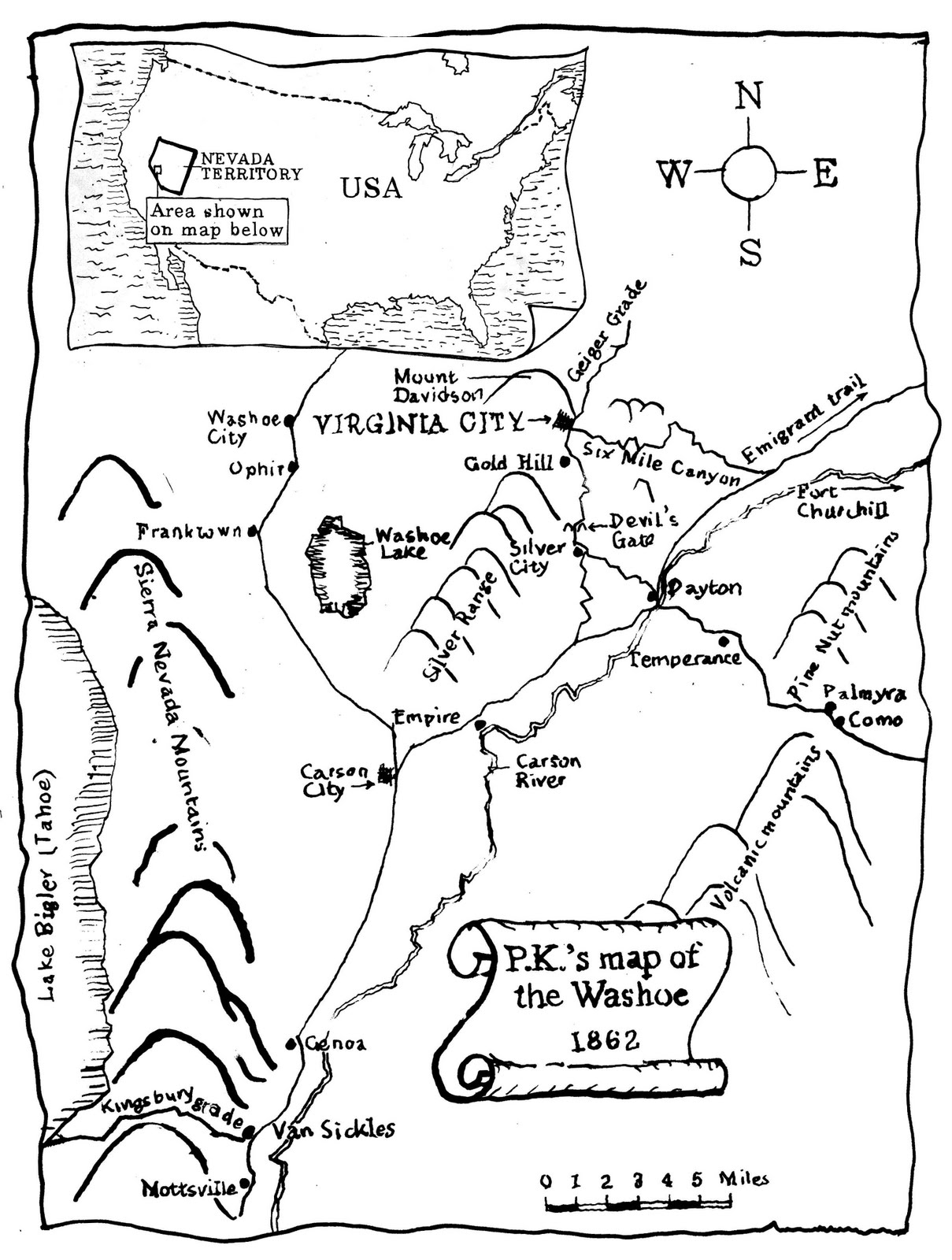
Map of the Washoe
Virginia City was a famous mining town in Nevada that sprang up on the slopes of Mt Davidson in 1859, ten years after the California Gold Rush. But it was silver, not gold, that was found in quantity in this barren part of Nevada, so some have dubbed it the Silver Rush. When Mark Twain arrived in September 1862 he described Virginia City in this way: ‘It claimed a population of fifteen thousand to eighteen thousand, and all day long half of this little army swarmed the streets like bees and the other half swarmed among the drifts and tunnels of the “Comstock”, hundreds of feet down in the earth directly under those same streets.’

In the 1860's Virginia City must have been one of the most colorful places on earth, with prospectors, miners, saloon-keepers, gamblers, dancing girls, deserters, actresses, desperados, lawyers, schoolmarms and newspapermen. In the last category are some well-known names (Dan De Quille, Alf Doten, Joe Goodman) and one stellar one: Mark Twain. Their dry-as-dust humor, tall tales and hoaxes produced a uniquely Western flavor of literature which some call "Sagebrush Humor."

Sam Clemens is Mark Twain
The Comstock in 1862 was an extreme example of what we might call "politically incorrect". People gambled, cursed, smoked, spat, drank, carried firearms, murdered one another, ate opium, sparked, and exhibited racism at its worst. It was an ethnic melting pot, boasting Irish, Germans, several tribes of Native Americans, African Americans, Chinese and Mexican residents. Many of the inhabitants had come west to avoid the horrors (or duty) of fighting in the War between the States. Almost everyone came to get rich, though there were a few who came to save souls of others or lose their own.

In short, Virginia City was a crucible; it made some great, and destroyed others. What will happen to 12 year old P.K. Pinkerton? Read the Western Mysteries to find out.

Western Mysteries author Caroline Lawrence will be talking about her new series at the Edinburgh Festival from 5.00-6.00pm on Friday 26 August 2011. For more info, and to book, go HERE.