Showing posts with label Virginia City. Show all posts

Monday, July 23, 2012

7 Tips for Writing Historical Fiction


"The past is a foreign country: they do things differently there"

mural in Virginia City Nevada
This famous opening line from L.P. Hartley’s The Go-Between is my key to writing historical fiction. I want my readers to really believe they are in the past and I also want them to learn about history. So whenever I start a new novel, I make use the following items, just as if I were going to a foreign country.


1862 Directory
1. Guide Book
Before I travel to a new country I always read a guide book about the history and customs. I do the same thing with traveling into the past. At the moment I’m reading books about the history of the American Civil War and the Silver Boom in Nevada. One of my best guide books is the 1862 Directory to Nevada Territory, an exact facsimile of the Wild West version of the yellow pages... or should I say 'Google'?

Bret Harte 1836-1902

2. Phrase Book

Just as it’s good to learn a few phrases when traveling to a foreign country, I like to get the speech patterns of the past down. For my Roman Mysteries, I made the language modern but used lots of Latin words. For the Western Mysteries I’m storing up choice phrases from the letters of Mark Twain and the diaries of Alfred Doten. (e.g. Americans in the 1800s didn't use many contractions, but they loved the word ain't.) I also listen to audiobooks to get the speech rhythms right, just as I'd listen to some language podcasts before going to Italy or France. One of my current favourites is Great Classic Westerns read by marvellous narrators like Bronson Pinchot. I also love the stories of Bret Harte.

Dressing the west
3. Clothing
Take the right clothes for climate and culture. Wearing period clothing can really get you into the mindset of your characters and make them seem real and immediate. For my Roman Mysteries, I wore a linen stola and woollen palla, plus leather sandals based on a Roman template. For my new Western Mysteries series, I have bought a buckskin jacket and cowboy boots. At the Santa Clarita Cowboy Festival, I learned my buckskin was actually pigskin! And one of my best experiences was a demonstration of what western women wore under their skirts during the 1860s. This took place during a Civil War re-enactment weekend in Virginia City at the Tahoe House Hotel. (left)

4. Food and Drink
The 19th century diarist Alf Doten tells me what he ate and drank on the Comstock in the 1860s. When I go to a foreign country, I want to eat what the locals do. Otherwise I may just as well stay home. Same thing when writing about the past. However, I do draw the line at grizzly-bear-cub mince-pies and oysters from tin cans, both dishes which Alf Doten appreciated. And I won't try the Pousse L'Amour drink in Professor Jerry Thomas's book on cocktails published in 1862: How to Mix Drinks, Or: The Bon-Vivant's Companion. If I did, I'd never get anything written!

Anne Dinsdale, weaver
5. Eyewitness - Talk to Someone Who’s Been There
It’s always a good idea to talk to a native of the foreign country if you can. The historical author has a wonderful resource in re-enactment events. Men who dress up as Roman legionaries usually know exactly what each piece of armour is for. Women who wear corsets and hoop skirts can describe how itchy and dusty they get. A Nevada Cowboy Fast draw expert told me why you usually only have five bullets in a six-shooter; it’s safest to leave the first chamber empty. Living history experts are the closest you’ll get to interviewing a person from the past. There are a lot of amateurs and experts eager to share their knowledge with you.

Virginia City rabbit
6. Go there!
Even if your story takes place centuries or millennia ago, it’s always useful to visit the site of the event if possible. You’ll meet people who are experts on the history of their region and who might know things not in books or on the internet. Also, you’ll get an idea of climate: wind, air, light, pressure, humidity, etc. I always like to make a note of what food is in season, what flora is blooming and fauna are migrating. Research is a great excuse to travel. Writing an historical novel gives you lots of fun goals as well as icebreakers for starting conversations with the natives.

7. Souvenirs
Whenever I visit the setting of one of my historical novels, I try to bring back a period artifact. It can be a genuine antique or a convincing replica. There is nothing like handling an object from your time period to bring it alive. If you write for children you can bring some of these artifacts to festivals, libraries and schools and let the kids handle them. My three favourites are my replica sponge-on-a-stick (ancient Roman toilet paper), my as of Domitian (an antique coin) and my brass spittoon from the 1890’s. (left)

These seven factors all contribute to making your setting real and your research fun. Employ them when you write and your book will become a time machine to transport your readers to another place and time.

The first book in my Western Mysteries series is The Case of the Deadly Desperados.

It is available in hardback and audio version


And you can find out about all my books on my website www.carolinelawrence.com

Wednesday, June 20, 2012

5 Colorful (Modern) Characters from Nevada

by Caroline Lawrence

Every author of historical fiction needs some mentors, advisors and allies. Elsewhere, I have been thinking about colorful characters of the Wild West but today I would like to introduce you five colorful characters of the Modern "Mild West" who have made my Western Mysteries a joy to research.


Above: Me and my sister Jennifer the driver (AKA 'Hawkeye') in 2008 about to go on a road trip to scout out a good location for a series of children’s historical novels set in California or Nevada. 

No. 1 - StinkE AKA StinkE
StinkE and me in 2008
In November of 2008, when I first arrived in Virginia City on a location scouting expedition with my younger sister Jennifer (AKA ‘Hawkeye’), the first person we saw was this guy. ‘Stop the car!’ I cried. Jennifer stopped the car and I got out and ran over to him. (I should explain that even in Nevada people do not usually dress like this. Especially on a week day.) ‘You look great!’ I gushed. ‘Who are you?’ ‘My name is StinkE with an E,’ he replied in an authentic drawl. Later on I discovered that he always dressed like this. Unless he undresses that is. I have since seen him in just his long-johns, thankfully with the back flap firmly in place. StinkE and Mrs. StinkE (yes, there is a Mrs StinkE!) are stars of Virginia City’s annual ‘outhouse’ race. He is usually the favorite. He has had lots of practice. I saw StinkE again in May 2012 and he introduced me to his donkey (see bottom of this post). ‘They never told me his mother was pregnant when they gave her to me,’ complained StinkE, ‘but on the fourth of July she gave birth to this one. So I named him Independence.’ When I gave StinkE a complimentary copy of my book, The Case of the Deadly Desperados, he shook my hand. I can now verify the fact that he has real, bona fide ingrained dirt!
(above: StinkE with a E and Caroline in November 2008)

No. 2 - McAvoy Layne AKA Mark Twain AKA 'Lazarus'
McAvoy Layne in Genoa, Nevada
Why was I considering Virginia City as the setting for a series of historical western books for kids? Several reasons, but the deciding factor was that Sam Clemens lived here before he became Mark Twain. Two years ago I was back in Virginia City with my sister Hawkeye. This time my husband Richard (AKA ‘Goes the Wrong Way’) was along for the ride. On our way home to California, we happened across the Genoa Cowboy Festival. As we drove through the oldest town in Nevada, all done up cowboy style, I saw this guy walking along the road. ‘Stop the car!’ I cried. (I shout that a lot.) Jennifer AKA ‘Hawkeye’ stopped the car and I leapt out and accosted Mr. ‘Mark Twain’. He graciously allowed me to get a snap of us together. I have since got to know McAvoy Layne. He is a clever, generous scholar and one of the best Mark Twain impersonators around. He is unofficial leader of a group of Nevada Historians who call themselves the ‘Never Sweats’. Here is how he signed off a recent email:
Your Eminent Beer Archon and Keeper of the Kalendar, e. Pluribus Lazarus, member in good standing of Our Lady of Perpetual Astonishment, Boss Poet of the Comstock, Capt. of the Clemens Cove
Volleyball, Drinking & Fighting Club, Emperor of the Hogwash Guild, Chief Liar by Seniority, and Friend of the Maid of Orleans

No. 3 - Guy Rocha AKA 'Rex Veritas'
Guy Rocha in Carson City
In Carson City, Guy Rocha is a celebrity. He once gave me an impromptu tour and everywhere we went people called out ‘Yo! Guy! How's it going?’ Recently bestowed with the hugely impressive title Distinguished Nevadan, he is a retired Nevada State Archivist, wrestling coach and 'Never Sweat'. I first met Guy on the internet via his Mythbusting series. Some people would call him a party-pooper. I call him a genius. Here is an excerpt from a Twainish tribute that McAvoy Layne (colorful character No. 2) composed for him:
He is the High Priest of Punsters, who can make lesser punsters go back down the hole they came out of to lick their wounds.
Persuasive? Rex can persuade a fish to come out and take a walk with him, and he will tell you a truth for a dollar, when he could get a dollar and a half for telling you a lie. Humor? Slip a little whiskey in his Red Bull, and Rex can make a cast iron dog laugh. Confidence? Rex Veritas carries with him the calm confidence of a Christian holding four aces. We all know Rex is the best historian in the Silver State, where facts are not essential, and whenever Rex uses a big word its meaning is usually a secret between himself and his maker. His face deserves to be framed in sagebrush, we firmly agree, and hung on the wall in the Rotunda in Washington, next to Mark Twain...
I couldn’t have put it better. In fact, I couldn't have put it anywhere near that genius. 
(above: Guy Rocha shows me a marker for historic Chinatown)

No. 4 - Carolyn Eichin AKA Proprietress of the B St House B&B
article by Carolyn Eichin
Every hero has a mentor, the wise person who sends them on the quest, gives them advice and often an object of great significance called a ‘talisman’. My mentor is Carolyn Eichin, proprietress of the B Street House B&B in Virginia City. Back in November of 2008, when my sister and I phoned to ask if they had a room, she said they were planning to go back to their winter quarters the day after but that they would delay their return to stay open one more day. This turned out to be not just a kindness, but serendipity in the highest. Not only is Carolyn a Nevada historian, but she is probably the best cook west of the Rockies. Her four-course breakfasts are legendary and will keep you going till suppertime. She has also become one of my most faithful proofreaders. Best of all, she gave me a 'talisman': the Diaries of Alf Doten. Like Mark Twain he was a failed prospector who became a journalist. Doten wrote about every aspect of daily life, from things as mundane as the cost of meals and laundry to exciting accounts of shoot-outs, mine disasters and suicides. 
(above: Pauline Markham from an article by Carolyn Eichin) 

No. 5 - Bob Stewart AKA The 'Unreliable'
Illustration by Kelly Davis
Another ‘Never Sweat’ is Bob Stewart, ex-newspaper-reporter, political aide and bureau of land management sage. Now a resident of Carson City, I first came across him when Carolyn Eichin (colorful character No. 4) told me about a lecture he was giving at the hotel in Silver City. Although his 'Never Sweat' nickname is the 'Unreliable' he is in fact hugely reliable. He is another one of my valued proofreaders. With a journalist’s attention to detail and accuracy, he is a font of information for Carson City and its environs. Although Bob is an expert in many areas, his current obsession is proving that a small unnamed cove on the Nevada side of Lake Tahoe is the place where Mark Twain once camped for a few days until he famously started a forest fire. The only problem is a California author also claims to have found the site and his cove is on the California side of Tahoe. So the two are feuding. Yes! Twain scholars clash over the site of a campsite! David Antonucci is Bob Stewart’s arch-nemesis! On Thursday, June 21 2012, they had a duello in South Lake Tahoe. Not pistols at dawn, but powerpoint at dusk. The debate took place on the grounds of the Gatekeeper's House Museum in Tahoe City.
(above: Bob Stewart on the left and David Antonucci on the right)

It has been a profound pleasure to have made such colorful friends over the course of researching my western mystery series. I guess it is just as well that, unlike them, I am sensible and sober. 
StinkE, StinkE's dog, StinkE's donkey and Caroline Lawrence


Caroline Lawrence's first Virginia City mystery, The Case of the Deadly Desperados, is out now. 

Tuesday, December 13, 2011

Saloon Archaeology Museum in Reno


tickets from Piper's Opera House
On the fifth floor of the Ansari Business Building at the University of Nevada's Reno campus is a gem of a museum, currently showing a fascinating exhibition of Western Archaeology. The University of Nevada, Reno Anthropology Research Museum is part of the Anthropology Department. At the time of writing (December 2011) the exhibition called Archaeology of the Mining West features artifacts from saloon digs at Virginia City, the Silver Boom town featured in the 1960s TV show Bonanza and now in my new Western Mysteries series of books for kids aged 9+. (There is also a small case of items from one of the excavations of the ill-fated Donner Party, where pioneers had to resort to cannibalism to survive.)

Jessica Axsom with pictures of a dig
I first heard about the museum from Dr. Jessica Axsom (left), an archaeologist at the Nevada State Historic Preservation Office in Carson City. Every morning for a week in November of 2011, Jessica gave me access to their little reading room so I could do research. On the last day she showed me a whole box of artifacts from Battle Mountain, (where my great-grandmother Corinne Prince was born in the 1870s.) Jessica also showed me pictures of her dig in the Chinatown area of Virginia City, where my books are set. She didn't have any artifacts from Virginia City, but she told me I could see some at the small Anthropology museum in Reno.

Ansari Business Building
Jessica told me to ask for Sarah Heffner, a graduate student in charge of the Virginia City exhibition. A few hours before we were due to fly out of Reno, my sister and husband and I drove to the impressive campus, found the Ansari Business Building and went up to the 5th floor. We were lucky enough to ride up in the elevator with someone who knew Sarah and she kindly took us to the museum. Serendipity: Sarah was there! The museum is literally one room with about half a dozen cases and a research room tucked behind. It is manned by graduate students like Sarah, a "Museum Technician", and volunteers like Robert. (The exhibit itself was designed by a Museum Training for Anthropologists class.)


Sarah Heffner, Caroline & volunteer Robert

antique bottles
A glass case explained that Dr. Donald Hardesty is the recently retired professor of archaeology who was responsible for excavating sites of the Pony Express, the Donner Party and various saloons in Virginia City. In the four or five cases devoted to artefacts found in his digs, I was thrilled to see items from various saloons around Virginia City. The Boston Saloon is particularly fascinating because it is the first African-American Saloon ever excavated. As Dr. Hardesty says, "Archaeology is another way of travelling into the past." Entering the Boston Saloon you might have seen a gaslit space filled with pipe smoke, the smell of lamb chops and fine wine, and the sound of trombone music above the babble of happy voices. (To find out how they deduced this, have a look at this 2-part film clip.)

cases in the small museum
Also on display were artifacts found on the site of Piper's Corner Bar, (later Piper's Opera House), the Hibernia Brewery and O'Brien & Costello's Shooting Gallery & Saloon. It was thrilling to see tickets from the Opera House, poker chips charred by Virginia City's great fire of 1875 and gun shells from beneath the saloon shooting-gallery. There was even evidence of children found in some of the saloons: marbles and a doll's arm! Yes, Virginia City was a wild place, even for kids.

toys from Piper's Opera House Saloon
Artifacts from saloons included bottles, bungs, white and red clay pipes, dice, animal bones, oyster shells, buttons, bullets, coins and even a tooth powder box. A water filter made in London and a glazed earthenware spittoon were represented by photos. There was also a case devoted to the Chinese population of Virginia City, (Sarah Heffner's special subject), including Chinese coins, pottery, tiny medicine bottles, a bone toothbrush and an opium pipe. It was a delightful half hour travelling back in the past. If you have any interest in the archaeology of the Wild West – or Virginia City – and find yourself on the Reno campus, I urge you to go along to the University of Nevada, Reno Anthropology Research Museum. Just tell them Caroline Lawrence sent you!

P.S. You can see more about Saloon Archaeology HERE and you can find out about the Western Mysteries HERE.

Monday, October 31, 2011

Twain's Bloody Massacre


Insensitive, moi?
Was a real life incident in July 1863 part inspiration for one of Mark Twain's most famous newspaper hoax articles?

[Warning: I am about to quote some fairly graphic descriptions of death by Bowie knife]

Before Mark Twain was a genial, white-haired, much-beloved raconteur, he was a hard-drinking, hot-tempered, pipe-puffing reporter with "mutton chop" sideburns and no mustache. (left) He lived in Virginia City (famous for being the setting of the TV series Bonanza) and he wrote for the Territorial Enterprise Newspaper. The Comstock, as that region was called, was wild and woolly, full of "thieves, murderers, desperadoes, ladies, children, lawyers, Christians, Indians, Spaniards, gamblers, sharpers, coyotes, poets, preachers, and jackass rabbits." Despite this rich vein of journalistic gold, Sam Clemens – who had not yet adopted the pseudonym Mark Twain – was not afraid of slandering local residents or even of making up hoax stories to fill blank pages of the paper.

His first hoax, early in October of 1862, was an article about a Petrified Man found in the Nevada desert east of Virgina City. Twain describes a prospector with a wooden leg who was found turned to stone at a place called Gravelly Ford. He describes the man's position, and if any of his readers had bothered to adopt the pose – or even mentally visualise it – they would have realised immediately that Twain was joshing them. (He even signed that article "Josh") One of his main aims in writing this hoax piece was to vex an enemy of his, a man named George Sewall with whom he was feuding. And he succeeded. People generally do not expect the printed word to be an outright lie.

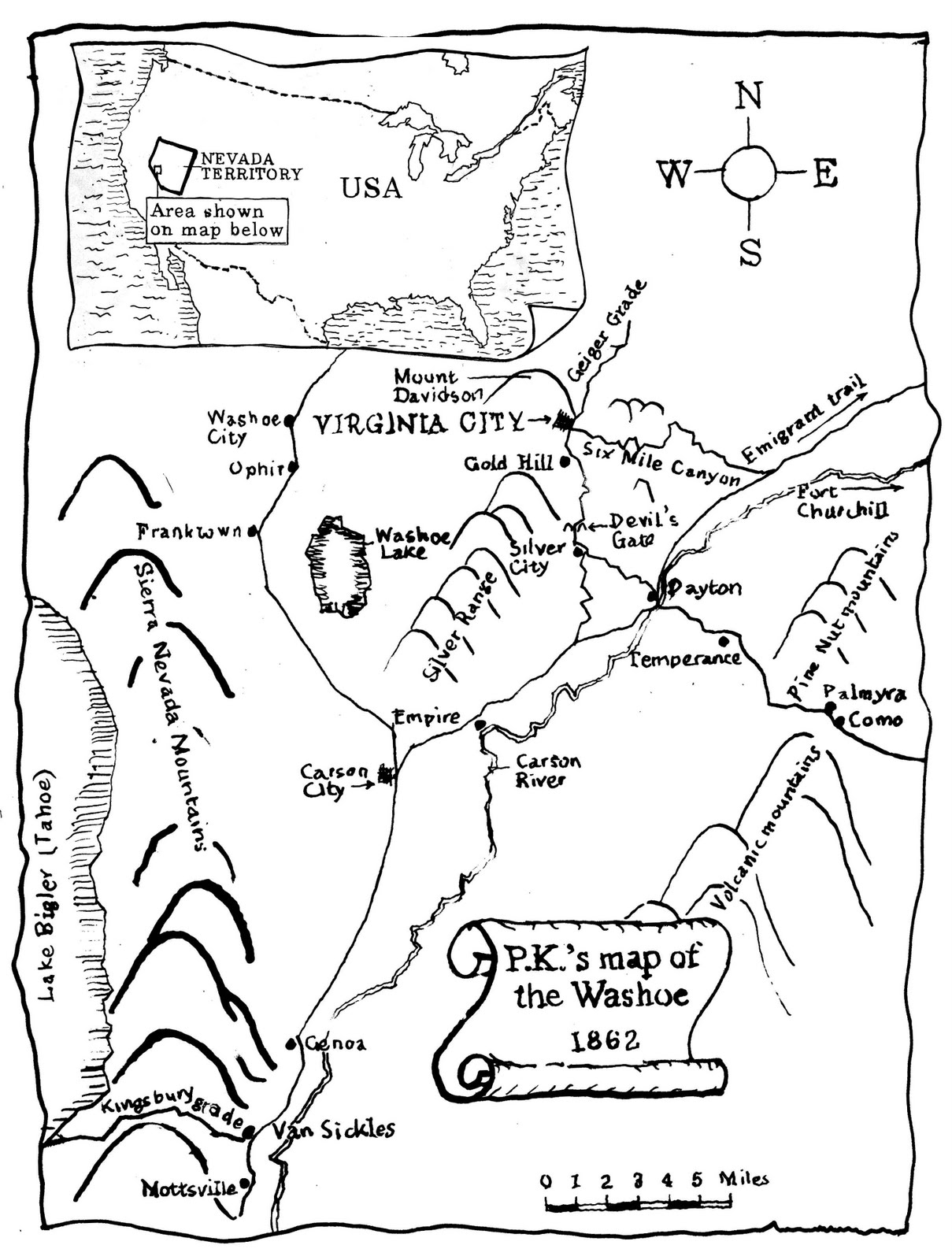
A year later, Twain wrote another hoax, a truly grisly piece about a man living in Empire City who supposedly kills and mutilates his family, cuts his own throat from ear to ear, then rides three miles before dropping dead on the steps of a Carson City saloon. Once again, careful readers would have read the clues and figured out that this story wasn't true. After all, how can a man ride three miles with his throat cut from ear to ear? (see map above right)

But readers of the morning paper pushed away their breakfasts in horror upon reading Twain's grisly report of the unhinged father's murder and mutilation of his family.

TE readers put off their breakfast by Twain's gory article

Territorial Enterprise, October 28, 1863

A BLOODY MASSACRE NEAR CARSON
From Abram Curry, who arrived here yesterday afternoon from Carson, we have learned the following particulars concerning a bloody massacre which was committed in Ormsby county night before last. It seems that during the past six months a man named P. Hopkins, or Philip Hopkins, has been residing with his family in the old log house just at the edge of the great pine forest which lies between Empire City and Dutch Nick's... About ten o'clock on Monday evening Hopkins dashed into Carson on horseback, with his throat cut from ear to ear, and bearing in his hand a reeking scalp from which the warm, smoking blood was still dripping, and fell in a dying condition in front of the Magnolia saloon... [even more graphically bloody details follow, which you can read HERE.]

The Journals of Alfred Doten

I've been reading (and re-reading) the Journals of Alfred Doten as part of researching my Western Mysteries stories set in and around Virginia City in the early 1860s. Like Mark Twain, Alf Doten was a failed prospector turned journalist. Throughout his life he kept meticulous and detailed journals, recounting the weather, cost of things and concrete details of life in the California gold fields and later on the Comstock, in Nevada.

This morning over breakfast I pushed away my own yogurt and strawberries in dismay as I read Doten's sad and distressing entry for 16 July 1863.

July 16 - About 8 oclock this evening a man by the name of Patrick Comerford committed suicide at the Mineral Hill tunnel, some 2 miles below here [Como, Nevada]. He was living near the mouth of tunnel with some half dozen others - he went into the tunnel and with a bowie knife he cut his throat - first ripped it up from upper part of breast bone to his chin & then cut across nearly from ear to ear, severing the jugular, windpipe &c - did the job securely - his partners heard him groan and went in and found him - he died in a few minutes - one of them immediately came up to town &c told the story - several people went down there - Briar went - he acted as Coroner and the jury gave verdict in accordance with the facts - he was an Irishman and about 35 or 40 yrs old - no reason could be assigned for the rash act - he seemed to be all right enough but somewhat troubled in his mind, and at times somewhat abstracted 
Journal of Alfred Doten p 719

As a writer who constantly draws inspiration from things I read and hear about, I am pretty sure that poor Patrick Comerfield's bloody suicide in July 1863 was partly the inspiration for Twain's "Bloody Massacre" hoax, written three months later. The gruesome details of Comerford's suicide must have spread like wildfire even if not reported by local papers.

Thus it is not too surprising that many Comstockers believed Twain's similar but greatly embellished account of a bloody suicide by Bowie knife. In fact, the article caused such horror and outrage that, Twain had to print this retraction the very next day:

Territorial Enterprise, October 29, 1863
I TAKE IT ALL BACK
The story published in the Enterprise reciting the slaughter of a family near Empire was all a fiction. It was understood to be such by all acquainted with the locality in which the alleged affair occurred. In the first place, Empire City and Dutch Nick's are one, and in the next there is no "great pine forest" nearer than the Sierra Nevada mountains, etc. 

[For more retrospection about this hoax read Mark Twain's Sketches New and Old.]

You would think Twain might have learnt his lesson, but no. Six months later, in May of 1864, he wrote a different sort of hoax, this one about the Ladies of Carson City. As a result of this third hoax the hot-blooded young reporter was challenged to a duel by pistol and had to flee Nevada. But that's another story.

[The second book in my Western Mysteries series, is called P.K. Pinkerton and the Petrified Man in the USA and The Case of the Good-Looking Corpse in the UK.]

Thursday, September 22, 2011

Western Mysteries ABCs

A basic GLOSSARY for British children reading the Western Mysteries who might not know what a Desperado or a Stagecoach is... or where Nevada and Utah are.

America in 1862

A is for America - the country across the Atlantic Ocean where people speak English with funny accents. It is also known as the United States, but in 1862, the states only went halfway across America with a few on the west coast. A great chunk of land in the west was called "Territory". Towns in the Territories were often lawless and wild.
Is P.K. a Desperado?
B is for Ball & Blackpowder - this is what old-fashioned bullets were made of. You also needed lint and a tiny little metal cap that you put on the back of each hole in the cylinder of your Revolver to make a spark which set off the powder and get the ball flying towards its target. Later on they put the cap and ball and powder in one metal case called a cartridge. This is what we now call a Bullet.
A Chinese Youth
C is for Chinese (not Cowboys) - in the early 1860s, when The Western Mysteries are set, there were far more Chinese out west than Cowboys. Cattle drives did not begin in earnest until 1866.
D is for Desperado - a desperate person who is usually on the run after committing murder, robbery or other serious crime.
E is for Emigrants - most of the people who flooded to America in the 1800s were emigrants from Euorpean countries like England, Scotland, Ireland, Germany, France, Russia, etc. And, of course, the thousands from China.
F is for Frontier - the place in the American West where settled land gave way to wilderness populated by wild animals and Native American tribes.
A Gunslinger
G is for Gunslingers - almost everybody carried a firearm in the 1860s out west, even women & kids.
H is for Horses - The West in the early 1860s was a world mostly driven and powered by animals with hooves like horses, mules and oxen.
An Indian Tomahawk
I is for Indians or Native Americans - the tribes of people already living in North America when the emigrants arrived were as varied as the people from European countries, sometimes more so.
J is for Jackrabbit, also coyote, grizzly bear, prairie dog, buffalo and all the other unique wildlife found in the West.
A Kerosene Lamp
K is for kerosene or coal-oil, which is what folk used to light their lamps. They used candles, too. In 1862 gas had not quite reached Virginia City.
L is for Lincoln - who was president between 1861 and 1865 when America was fighting a terrible Civil War over slavery and freedom.
26-year-old Mark Twain
M is for Mark Twain - his real name was Sam Clemens and he was one of America's greatest authors and humorists. He joined the Civil War for about two weeks then headed west to Nevada Territory with his brother Orion, who had been appointed secretary to the governor. After trying his hand at prospecting, Mark Twain became a reporter in Virginia City where he remained for two and a half years. Many years later he wrote Tom Sawyer & Huckleberry Finn, among others.
N is for Nevada - then a "Territory" and now the triangular state to the right of California, (see maps). It is full of deserts, mountains and minerals.
O is for Ore - rock and/or dirt containing precious metals or minerals. The Gold Rush in 1849 brought a huge wave of people to California, then ten years later the Silver Boom brought thousands Nevada, to the Comstock Lode beneath Mount Davidson.
P is for Pinkerton - the first detective agency in the world. The founder, a Scotsman named Allan Pinkerton, coined the phrase "Private Eye". Their head office was in Chicago, Illinois (one of the high-up states in the middle).
A Quartz Stamp Mill
Q is for quartz stamp mill - a machine with heavy iron pistons that crushed quartz so that silver and gold could be extracted.
R is for religious revival - America was going through a great Christian revival in the 1860s and almost everybody was deeply devout.
S is for stagecoach - a large, closed carriage pulled by four to six horses; it was used to carry passengers, goods and mail on a regular route. Sometimes you could ride on top.
T is for tobacco - like religion, almost everybody had tobacco. They either smoked it, sniffed it or chewed it. Those who chewed usually spit their tobacco-tinted saliva into vessels called spittoons. Ew.

A Stagecoach

U is for Utah - now the state to the right of Nevada on a map, then it was a "Territory", a part of America which did not yet have the full rights of the other states.
Nevada Territory 1862
V is for Virginia City - the mile-high city on a steep mountain above a buried "ledge" of silver called the Comstock Lode.
W is for Washoe - the region around Virginia City, named after a lake to the west (see map) and also a tribe of Indians who lived there.
X is for "X marks the Spot" - Prospectors were people who prospected or "looked out for" areas where gold or silver could be found. Then they "staked their claim" i.e. announced it as theirs. They guarded their claims with bowie knives, revolvers, rifles... and their lives.
Y is for Yankee or Yank - slang for somebody from the northern states or on the Union side of the Civil War. A person on the other (Confederate) side was often called a Reb or Rebel.
Washoe Zephyr
Z is for zephyr - by definition a warm and gentle breeze. In Virginia City, a Washoe Zephyr was what people jokingly called the gale force wind that sometimes swept over the mountains and threatened to uproot trees and houses.

If you would like to read a book with all these words and a heck of a lot of adventure, get The Case of the Deadly Desperados by Caroline Lawrence. It is available in hardbackKindle and unabridged audiobook format. Suitable for children aged 9+. Perfect for American history at Key Stages 2 & 3.

Wednesday, August 17, 2011

Virginia City 1862


Virginia City, Nevada Territory - September 1862.

P.K. Pinkerton, Private Eye
When desperados kill the preacher and his wife in a small frontier town, their foster child P.K. is forced to go on the run. P.K. must get a valuable letter to the Recorder’s Office before anyone else can get their hands on it. It’s not easy: Virginia City is full of gamblers, hurdy girls, saloon-keepers and gunmen, all of them on the make. But there are possible allies: Sam Clemens, the new reporter for the paper, a gambler called ‘Poker Face Jace’, a derringer-packing Soiled Dove, and a Chinese photographer’s apprentice named Ping.

Map of the Washoe
Virginia City was a famous mining town in Nevada that sprang up on the slopes of Mt Davidson in 1859, ten years after the California Gold Rush. But it was silver, not gold, that was found in quantity in this barren part of Nevada, so some have dubbed it the Silver Rush. When Mark Twain arrived in September 1862 he described Virginia City in this way: ‘It claimed a population of fifteen thousand to eighteen thousand, and all day long half of this little army swarmed the streets like bees and the other half swarmed among the drifts and tunnels of the “Comstock”, hundreds of feet down in the earth directly under those same streets.’

In the 1860's Virginia City must have been one of the most colorful places on earth, with prospectors, miners, saloon-keepers, gamblers, dancing girls, deserters, actresses, desperados, lawyers, schoolmarms and newspapermen. In the last category are some well-known names (Dan De Quille, Alf Doten, Joe Goodman) and one stellar one: Mark Twain. Their dry-as-dust humor, tall tales and hoaxes produced a uniquely Western flavor of literature which some call "Sagebrush Humor."

Sam Clemens is Mark Twain
The Comstock in 1862 was an extreme example of what we might call "politically incorrect". People gambled, cursed, smoked, spat, drank, carried firearms, murdered one another, ate opium, sparked, and exhibited racism at its worst. It was an ethnic melting pot, boasting Irish, Germans, several tribes of Native Americans, African Americans, Chinese and Mexican residents. Many of the inhabitants had come west to avoid the horrors (or duty) of fighting in the War between the States. Almost everyone came to get rich, though there were a few who came to save souls of others or lose their own.

In short, Virginia City was a crucible; it made some great, and destroyed others. What will happen to 12 year old P.K. Pinkerton? Read the Western Mysteries to find out.

Western Mysteries author Caroline Lawrence will be talking about her new series at the Edinburgh Festival from 5.00-6.00pm on Friday 26 August 2011. For more info, and to book, go HERE.

Monday, December 14, 2009

Stagecoach #2

In the 1860's there were at least half a dozen stage coaches in and out of Virginia City every day.

In a book called Resources of the Pacific Slope, J. Ross Browne gives details of the routes of a dozen stages in the 1860's. For example, Route #1 went to Sacramento California via the Donner Pass and North Lake Tahoe. It cost $20 to Sacramento but $25 back because that was the most popular direction of travel in the 60's. Another stage went down to Dayton and from there to Como across the Carson Valley. Some stagecoaches went up to an area called Humboldt and from there to Salt Lake City and the east.

As our time in Virginia City is now over, we decide to follow Stagecoach Route #2 to California. J. Ross Brown tells us exactly which towns it passed through: Gold Hill, Silver City, Empire, Carson City, Genoa, Van Sickles Station, then up the Kingsway Grade to Dagget Pass at the summit and down into California via Strawberry, Placerville and Shingle Springs, all the way to Sacramento.


It's a beautiful September morning as we get in our convertible 'stagecoach' and set out from Virginia City to follow this route. We leave at 10.00am, and five minutes later we go over the hump called 'The Divide' which marks the boundary between Virginia City and Gold Hill. The Civil War re-enactors staged a mock battle here in a quarry beside the train tracks. Of course the Civil War never got this far west, and the V&T train wasn't here in 1862, when my first book will be set. However, the Gold Hill Hotel was. It's the oldest hotel in Nevada. Sam Clemens, Dan De Quille and Alf Doten all ate there.

Down the hot, winding road through a pair of dramatic rocks (above) called Devil's Gate. This was a popular place for bandits to lie in wait to rob the stage. An old illustration exaggerates the size of the rocks by putting tiny people between them. Exaggeration was rife in the 1860's... We breathe a sigh of relief as we pass through Devil's Gate into Silver City without incident.

As we pass an abandoned mine just out of Silver City we wave to our friend 'Irish'. He runs the Comstock Gold Mine and Stamp Mill and we met him when he demonstrated how the ore stamps worked and sounded. He is a colourful character who first came to Virginia City as a 16 year old in 1958. LIke many others, the popular TV show Bonanza was what brought this region to his attention. He went back to California to be a roadie for The Grateful Dead and Willie Nelson, but now he has ended up back here in a fabulous 'boys' fort' type of dwelling on the golden, sage-dotted hills.

After Silver City, the road flattens out into the wide flat Carson River Valley. We join Hiway 50 here. If we were to go left we would reach Dayton, which might be Nevada's oldest town. My great-grandmother Corinne Prince grew up there. Her father was a teamster, one of those men who drove eight to twelve-mule carriages with loads of ore going out and timber coming back. Corinne probably went to school in the Dayton School house, which was built in 1863 and is now a museum.

But our 'stagecoach' doesn't go left to Dayton. It goes right, west, to Empire. We can't really see any signs of old Empire; New Empire is a suburb of Carson City. But in Carson City we see the old mint, where my great-grandmother worked for a while, and the governor's mansion. Stages might have changed teams here in Carson, as it's about 20 miles from Virginia City.

A road west takes you towards the Sierra Nevada mountains, which are barren and rounded and steep on this side. Then the flat road curves south to Genoa. Originally known as Mormon Station, Genoa is a pleasant surprise. It's green and shady with excellent information about the pioneers and local characters like Snowshoe Joe, who was a mail carrier. Genoa and Dayton have a little rivalry going on as to which of them is the oldest town. Let's just say they are both old, founded in 1851. Richard and I stop for an espresso on the rocks at the delightful Genoa Coffee & Candy Company. We go to see the famous hanging tree before setting out south with a 'fresh team of horses.'

There are hot springs south of Genoa and today David Walley's Hot Springs is a popular place to get married. Half a mile south, on the right of the road, is Van Sickles Station Ranch, now a private residence. Van Sickles was a commissioner and in the early 60's his hotel was the first port of call once you crossed the mountains. With hot water and good food, it must have been a joy for the weary traveller. In winter you could sledge down the eastern Sierras. Van Sickles was famous for shooting a desperado called Sam Brown who had killed half a dozen men. After Sam fired on Van Sickles, the hotel owner went after him with a shotbun. He was later tried and a jury passed a verdict of 'self-defense'.

The eastern side of the Sierra Nevada mountains come straight down and stop dramatically at the flat plain of the Carson Valley. One minute you're on the flat, the next you're climbing the Kingsbury Grade. This wagon road was built by two men named Kingsbury and MacDonald in 1860, it shortened the distance between Virginia City and Sacramento by 15 miles. The road cost $585,000 to build and the builders charged a toll to pay for the road. A wagon and four horses had to pay $17.50 for a round trip from Shingle Springs to Van Sickles Station. The Pony Express used this road, too, for the short period of its existence between 1860 and 1861.

The four-horse team strains as it pulls our stagecoach and up over sparsely wooded eastern slopes with dizzy views down to the flat Carson Valley. Once over Dagget Pass, tall pines and smooth grey granite boulders take over. The summit is over 7400 feet, then down to Lake Tahoe, blue and peaceful in the warm September sun. When we were in Virginia City, we took a ten minute stagecoach ride with Gary. What you don't realise until you try riding as a passenger in one is how claustrophobic it can be. You can't see what's coming and the scenery whizzes by. If you were sitting facing backwards it might have been quite disconcerting. Not good for people who are easily travel-sick. The idea of taking a bone-rattling stagecoach all this way is almost inconceivable. Especially knowing that they sometimes travelled at night around the precipitous bends. Eeek!

After the pass, Richard and I stop at South Lake Tahoe for lunch. In the 1860's people were often malnourished because fresh fruit and veg were almost impossible to find apart from the autumn. We know from J. Ross Browne and others that staple foods were corn-meal, lard, bacon, eggs, potatoes, cabbage, cheese, sugar and coffee, When Sam Clemens arrived in Virginia City in 1862, a man called Rollin M. Daggett remarked that he 'had been living on alkali water and whang leather...' This is an exaggeration, of course, but gives you an idea of the monotony of food back then.

Strawberry was one of the most famous stopping places on the western Sierra Nevada Mountains. There were no strawberries there, but according to some reports, a man called Berry owned the inn and he had straw for the horses. Another article by J. Ross Browne, first published in Harper's Monthly Magazine, December 1860 documents the first wave of prospectors coming over the Sierra Nevadas to mine gold and silver on the Comstock. Some of his most hilarious anecdotes take place at Strawberry.

The illustration above right shows 'Dinner at Strawberry', an illustration from 'A Peep at Washoe'. A light at length glimmered through the pines, first faint and flickering, then a full blaze, then half a dozen brilliant lights, which proved to be camp fires under the tree, and soon we stood in front of a large and substantial log-house. This was the famous Strawberry', known throughout the length and breadth of the land as the best stopping-place on the route to Washoe...

Soon the road shows glimpses of the American River on the left. Further down in Coloma gold was discovered for the first time in 1848 with the cry: 'Gold. Gold in the American River!' The road down the western Sierra Nevadas is a much gentler grade. It takes us into the hot valley and Placerville, which was once known as Hangtown. Placerville was named after 'placer' mining, the method where you pan for gold in an open stream or creek. Placerville's Main Street still has buildings dating back to the 1850's and you can see Stage Coach Alley. You can also get a hot dog at Hangville Hot Dogs. This was another staging place for horses. After Placerville it is on to Shingle Springs.

We tried to find the old train station at Shingle Springs but only founded traces of the old track in a cutting of earth red with iron. The train arrived here in 1865, but until then you would carry on in your stagecoach to Sacramento, another 30 miles on. At last you could emerge and take a different method of transport: boats plied daily from here to San Francisco. I'll bet plenty of travellers vowed never to sit in a stage coach again!

TIPS FOR STAGECOACH TRAVELERS

The best seat inside a stage is the one next to the driver. Even if you have a tendency to sea-sickness when riding backwards - you'll get over it and will get less jolts and jostling. Don't let "sly elph" trade you his mid-seat.

In cold weather, don't ride with tight-fitting boots, shoes or gloves. When the driver asks you to get off and walk, do so without grumbling, he won't request it unless absolutely necessary. If the team runs away - sit still and take your chances. If you jump, nine out of ten times you will get hurt.

In very cold weather abstain entirely from liquor when on the road, because you will freeze twice as quickly when under its influence.

Don't growl at the food received at the station - stage companies generally provide the best they can get.

Don't keep the stage waiting. Don't smoke a strong pipe inside the coach. Spit on the leeward side... Don't lean or lop over neighbours when sleeping. Take small change to pay expenses. Never shoot on the road as the noise might frighten the horses. Don't discuss politics or religion.

Don't point out where murders have been committed, especially if there are women passengers.

Don't lag at the wash basin. Don't grease your hair, because travel is dusty. Don't imagine for a moment that you are going on a picnic. Expect annoyances, discomfort and some hardships. (Omaha Herald 1877)


P.S. Listen to a fun audio account of a young Englishman's stage journey across America in 1859 on the Wells Fargo History site.